
How Strategic Warehouse Locations Support Complex Logistics
When companies evaluate warehousing, the conversation often starts with space.
How much inventory can the facility hold? How many dock doors does it have? Can it accommodate oversized freight? How long can products remain in storage?
Those questions matter, but there is another factor that can have just as much impact on a logistics program: location.
Where inventory is stored affects how quickly it can reach its final destination, how easily a project can respond to schedule changes and how efficiently a company can support multiple locations across different markets.
For a national rollout, retail program, hotel renovation or high-value equipment project, relying on one or two warehouses can create unnecessary transportation miles and make final-mile coordination more complicated.
A strong warehouse network gives businesses another option.
Instead of forcing every shipment through the same facility, inventory can be positioned strategically based on where and when it will ultimately be needed.
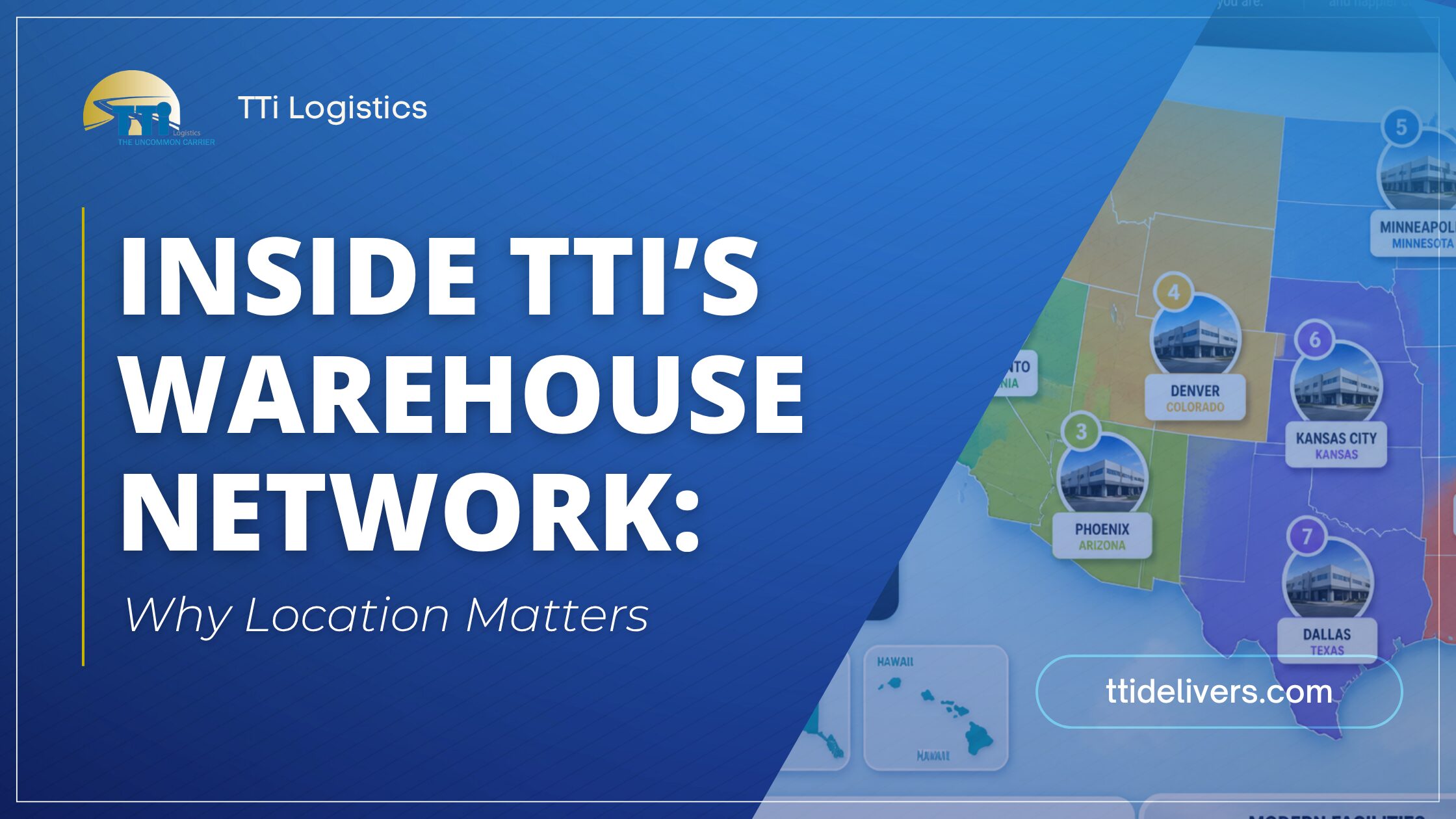
At TTi Logistics, our network of 700+ warehouses across the United States and Canada helps us support projects wherever the next delivery needs to happen. But the value of a warehouse network goes far beyond having more dots on a map.
Here is why location matters—and how the right warehousing strategy can help keep complex logistics projects moving.
A Warehouse Is More Than a Place to Store Freight
Warehousing is sometimes treated as the waiting room of the supply chain.
Freight arrives. It sits. Eventually, it leaves.
For complex logistics projects, the warehouse should play a much more active role.
It can serve as the point where products from different vendors are received, inspected, documented, organized, consolidated and staged before final delivery.
That becomes particularly important when products do not arrive in the same order they will ultimately be needed.
Consider a hotel renovation.
Furniture may come from one manufacturer. Lighting may come from another. Artwork, mirrors, fixtures and equipment may each have separate vendors and production schedules.
The construction team, however, may need those products delivered according to a completely different sequence.
The warehouse creates the bridge between the vendor schedule and the project schedule.
A strong warehouse network takes that concept one step further by giving project teams the ability to create that bridge in multiple markets rather than relying on a single centralized facility.
Why Warehouse Location Matters
The closer inventory is positioned to its final destination, the more options a logistics team may have when it is time to execute the final delivery.
Imagine a company preparing to refresh 200 retail locations across the country.
If every fixture is routed through one warehouse, freight may need to travel hundreds—or thousands—of additional miles before reaching some locations.
A nationwide warehouse network can allow inventory to move into facilities closer to the regions where installations will take place.
That can create a more practical staging point for the final mile.
Location becomes even more valuable when schedules change.
If a project scheduled for next month suddenly moves forward, having inventory staged within the region can make it easier to evaluate transportation options and respond to the new timeline.
The warehouse is no longer simply storing freight.
It is helping position that freight for what happens next.
National Projects Need Local Support
One of the challenges of managing a national logistics program is maintaining consistency across different markets.
A company may have projects happening simultaneously in Florida, Texas, California, New York and the Midwest.
Each location may have different site requirements, construction schedules and delivery windows yet the customer still needs one consistent logistics process.
This is where the scale of a warehouse network becomes especially valuable.
TTi Logistics has access to 700+ warehouse locations throughout the United States and Canada. That footprint allows our team to support projects across multiple regions while coordinating them as part of a larger logistics program.
Instead of a customer finding a new warehouse provider every time a project enters another city, the warehousing strategy can remain connected to the broader transportation and project management plan.
That matters because adding more vendors does not always make a logistics program more flexible. Sometimes, it simply adds more people to manage.
Warehousing Becomes Critical During Multi-Location Rollouts
Multi-location rollouts rarely happen all at once.
A retailer may refresh 20 stores this month, 35 next month and another 50 the month after that.
A hospitality group may renovate one floor at a time.
A healthcare organization may replace equipment across facilities according to regional schedules.
The freight associated with those projects may arrive much earlier.
That creates a timing gap.
Manufacturers want to ship when products are ready. Jobsites want to receive when they are ready.
Those two dates are not always the same.
A warehouse network gives the logistics team places to manage that gap.
Inventory can be received and organized before the site is ready for delivery. As project dates approach, the freight can then be staged and released according to the rollout schedule.
For larger programs, this also creates an opportunity to position inventory regionally.
Rather than managing every delivery from one centralized point, products can be staged closer to groups of upcoming locations.
The result is a warehousing strategy built around the rollout rather than forcing the rollout to work around the warehouse.
The Right Warehouse Can Improve Inventory Visibility
Location matters, but geography alone does not make a warehouse useful.
What happens inside the facility is equally important.
For complex projects, inventory needs to remain identifiable and organized from the moment it arrives.
That can include tracking which customer, purchase order, project, location, floor, room or installation phase an item belongs to.
Otherwise, a warehouse full of inventory can quickly become a warehouse full of questions.
Has the complete order arrived?
Which cartons belong to the next location?
Was anything damaged during transit?
Which items are ready to release?
What is still missing?
Where is the product physically located?
A well-managed warehouse network should provide more than square footage. It should support the visibility needed to answer those questions before freight reaches the jobsite.
TTi can support receiving, inventory management, consolidation, staging and photo documentation to help customers maintain visibility throughout the warehousing process.
Because discovering a missing item while it is still in the warehouse is one thing.
Discovering it after the installation crew is standing onsite is another.
Consolidating Multiple Vendors Before Final Delivery
Many complex projects involve products coming from several manufacturers.
If every vendor ships directly to the jobsite, the site may receive deliveries on different days from different carriers with little connection to the actual installation schedule.
That can create congestion, confusion and additional work for onsite teams.
Warehousing provides an opportunity to consolidate those shipments before the final mile.
Products can arrive from multiple vendors, be organized according to the project and then be staged for coordinated delivery.
Instead of asking a jobsite to manage six separate vendor shipments, the logistics team can help create a more controlled delivery sequence.
Across a large warehouse network, that same model can be applied in multiple regions.
This is particularly useful for national retail rollouts, hospitality renovations and other projects where several product categories must come together at the same destination.
The final delivery becomes less about when individual vendors are ready to ship and more about when the project is ready to receive.
Location Can Make Schedule Changes Easier to Manage
Logistics plans change because project plans change.
Construction schedules move.
Permits are delayed.
Installation dates shift.
Locations open earlier than expected.
A vendor misses a production deadline.
Weather interrupts transportation.
No warehouse strategy can eliminate those changes.
The goal is to build enough flexibility into the logistics plan to respond when they happen.
A broad warehouse network can give project teams more options when timelines move.
If inventory is already positioned within the appropriate market, the logistics team can evaluate what is available and determine how quickly it can be released.
If a location is delayed, freight can remain in storage rather than arriving at a jobsite that cannot receive it.
This flexibility becomes increasingly important as projects scale.
One schedule change may be easy to manage.
Twenty schedule changes happening across a national rollout require a system capable of keeping track of the bigger picture.
The Warehouse and Final Mile Should Work Together
Warehousing and transportation should not operate as two unrelated parts of the project.
What happens inside the warehouse directly affects what happens during final delivery.
If inventory is poorly labeled, the wrong freight can be pulled.
If a shipment has not been inspected, damage may not be discovered until delivery.
If products are not staged according to the project schedule, loading and unloading can become less efficient.
If the warehouse does not know that a site requires a specific delivery sequence, the truck may be loaded in a way that makes onsite execution more difficult.
A connected warehouse network allows warehousing decisions to support the final-mile plan.
Before freight leaves the facility, teams can verify what is being released, where it is going, what equipment may be required and how the site expects the delivery to occur.
That becomes especially valuable for white-glove projects where the job does not end at the loading dock.
TTi can coordinate specialized equipment, liftgate service, inside delivery, room-specific placement, installation and other project requirements as part of the larger logistics plan.
Specialized Freight Needs the Right Environment
Not every product belongs in a standard distribution environment.
Retail fixtures, furniture, medical equipment, electronics and other high-value products may require additional care while they are being handled and stored.
The warehouse needs to be able to accommodate the freight itself—not simply have available space.
That may mean evaluating dock access, handling procedures, security, storage configuration, specialized equipment or other project-specific requirements.
Having access to a large warehouse network gives TTi the ability to evaluate warehouse options based on the needs of the project and the market being served.
That distinction matters.
The nearest warehouse is not automatically the right warehouse.
The goal is to identify a facility that makes sense geographically and operationally.
A Warehouse Network Creates Scalability
A project that begins in one market may not stay there.
A retailer testing a new store concept in 10 locations could eventually expand it to 100.
A healthcare equipment program could move from one region to multiple states.
A hospitality brand may have renovation projects planned across its portfolio.
The logistics infrastructure needs to be able to grow with that demand.
A nationwide warehouse network creates a foundation for that growth.
Instead of starting over every time the project enters a new market, the logistics team can evaluate warehouse options within an established network and connect those facilities to the same overall transportation strategy.
That can help create consistency even as the geographic footprint grows.
The customer still has one logistics program.
It simply has more places where inventory can be positioned.
One Network, One Logistics Strategy
The value of a warehouse network is not simply the number of facilities available.
It is the ability to connect those facilities into one coordinated logistics strategy.
At TTi Logistics, warehousing can be integrated with transportation, project management, final-mile delivery and installation.
Depending on the project, that can include receiving and inspection, inventory management, photo documentation, storage, consolidation, staging, scheduled delivery, specialized handling, inside delivery and installation.
For customers managing multiple locations, that means warehousing does not have to become another disconnected piece of the project.
It can become the control point that helps connect vendor shipments to the final destination.
700+ Warehouses. One TTi Team.
The best warehouse location is not always the one closest to where a product was manufactured.
It is the one that makes sense for what happens next.
Where is the freight ultimately going?
When will the site be ready?
What other products need to arrive first?
Does the shipment need to be consolidated?
What type of final-mile delivery will be required?
Could the project schedule change?
Those questions turn warehousing from a storage decision into a logistics strategy.
With access to 700+ warehouses across the United States and Canada, TTi Logistics can help customers position inventory closer to where it will ultimately be needed while connecting warehousing to the rest of the project.
Whether you are coordinating one high-value delivery, a regional expansion or hundreds of locations across a national rollout, the right warehouse network can help create the visibility, flexibility and scalability your project needs.
Because when the final destination matters, where your freight waits along the way matters too.