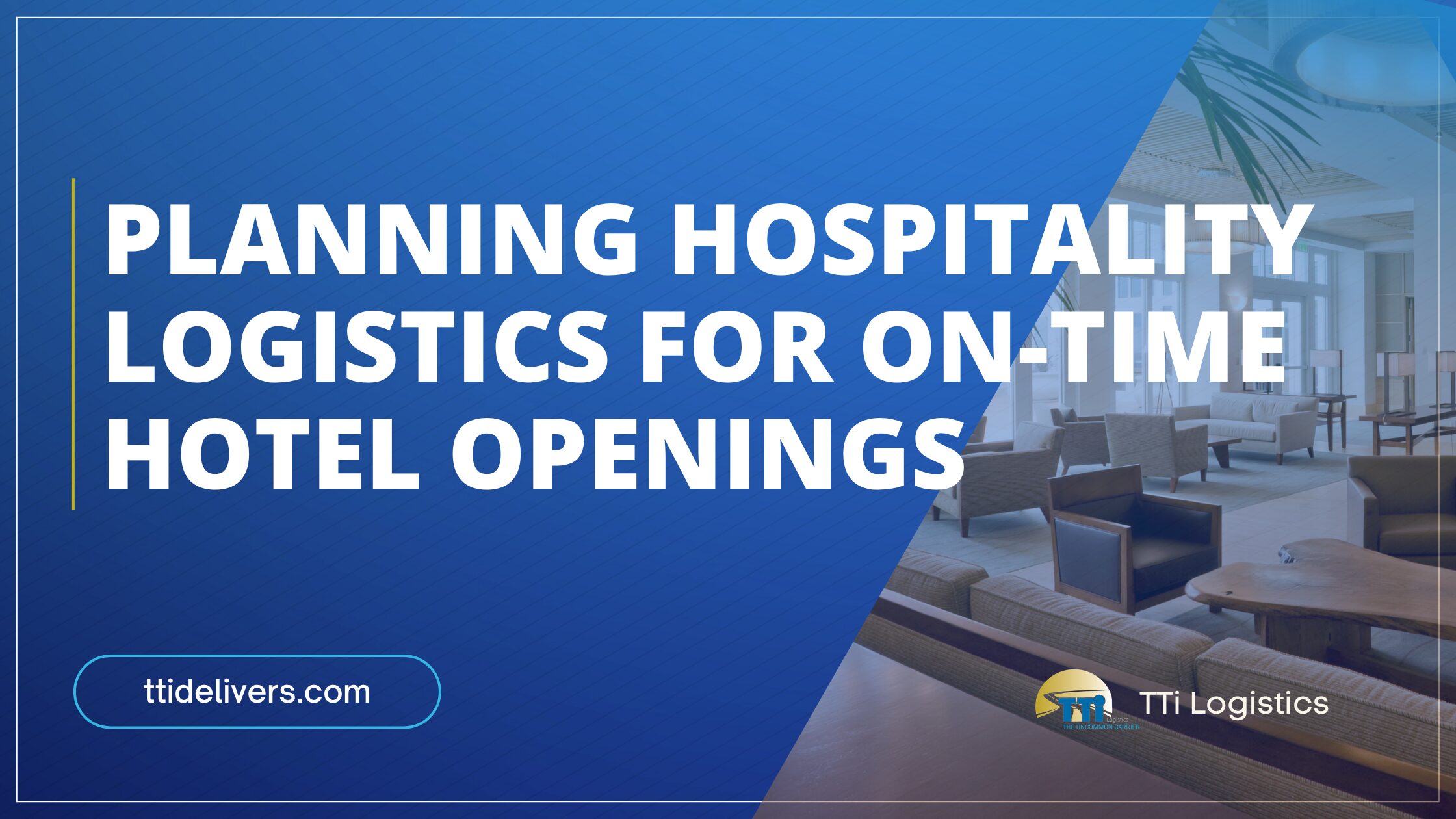
Why Hotel Openings Rarely Fail for the Reason Owners Expect
When a hotel opening slips past its target date, most people assume construction is to blame. Sometimes it is. But in a surprising number of cases, the building is ready and the crews are finished — while furniture, fixtures, and equipment are still sitting in a truck, a distant warehouse, or a customs hold somewhere between the manufacturer and the property.
This is the quiet reality of hospitality logistics: it rarely makes headlines, but it determines the actual opening date far more often than the construction schedule does. Every hotel renovation or new build depends on thousands of individual items — furniture, lighting, artwork, mattresses, casegoods, soft goods — arriving at the right place, at the right time, in the right condition. Hospitality logistics is the discipline of making that happen.
This article breaks down what hospitality logistics actually involves, the questions project teams should be asking, and why so many hotel projects underestimate it until it’s already causing delays.
What Does Hospitality Logistics Actually Involve?
Hospitality logistics covers everything that happens to FF&E — furniture, fixtures, and equipment — between the moment it’s ordered and the moment it’s installed in a guest room, lobby, or common area. That includes:
- Coordinating inbound transportation from manufacturers, both domestic and international
- Warehousing inventory until it’s needed for installation
- Tracking purchase orders and shipment status across dozens or hundreds of vendors
- Organizing inventory so it can be located and staged quickly
- Scheduling deliveries in a sequence that matches construction and installation progress
- Managing exceptions when items are delayed, damaged, or backordered
On paper, this can look like a straightforward transportation and storage function. In practice, hospitality logistics is closer to project management — because a single missed detail in any one of these areas can delay an entire floor, wing, or opening date.
Is Hospitality Logistics Different From Standard Freight Logistics?
Yes, and the difference matters more than most project teams expect going in. Standard freight logistics is often measured by whether a shipment arrived. Hospitality logistics is measured by whether the right items arrived in the right sequence to keep installation crews working without interruption.
A hotel renovation might involve hundreds of individual SKUs arriving from dozens of vendors across different countries, all needing to converge at the right time for a specific floor or room block. That level of coordination requires more than transportation — it requires a logistics partner who understands construction sequencing, installation priorities, and how to adapt when any part of that sequence shifts.
Why Do Hospitality Projects Fall Behind Schedule?
Hotel renovation and development timelines are ambitious by nature. Ownership groups want rooms generating revenue as quickly as possible, and construction teams are often working against tight, firm deadlines. Hospitality logistics has to keep pace with that urgency — but a few recurring issues tend to get in the way.
Procurement Timing Doesn’t Match Installation Timing
FF&E is often ordered based on budget approval cycles or design finalization, rather than around the actual installation schedule. When procurement and installation timing aren’t aligned, items can arrive either too early — creating unnecessary storage costs — or too late, creating direct installation delays.
Inventory Becomes Difficult to Locate
Large hospitality projects generate enormous volumes of inventory. Without a clear system for organizing that inventory by floor, room block, or installation phase, warehouse teams can spend valuable time simply searching for items instead of staging them for delivery.
Construction Timelines Shift — But Logistics Plans Don’t
Construction rarely proceeds exactly as originally scheduled. Weather, permitting, and trade sequencing can all move deadlines earlier or later. Hospitality logistics plans built around a single fixed schedule often struggle to adapt when that schedule inevitably changes.
No Single Point of Accountability
When freight, warehousing, and delivery scheduling are split across multiple disconnected vendors, information becomes fragmented. No one has the complete picture, and small issues can go unnoticed until they become schedule-threatening problems.
What Questions Should Project Teams Be Asking About Hospitality Logistics?
Whether hospitality logistics is being handled well often comes down to whether project teams are asking the right questions early enough — before problems surface on the jobsite.
Do we know exactly where every shipment is right now?
Real-time visibility into inbound freight, whether it’s still overseas, in customs, or already in a domestic warehouse, allows teams to plan around delays instead of discovering them after the fact.
Is our warehouse organized around installation, not just storage?
A warehouse full of correctly received inventory still creates delays if that inventory can’t be located and staged quickly by floor, room, or installation phase.
Can our delivery schedule adjust if construction timing changes?
If ownership decides to open a floor early, or a contractor finishes ahead of schedule, can inventory move to meet that new timeline? Rigid delivery plans struggle here. Flexible hospitality logistics does not.
Who is the single point of contact if something goes wrong?
When a shipment is delayed or an item arrives damaged, is there one person coordinating the response — or does the issue bounce between multiple vendors before anyone takes ownership of a solution?
What Does Strong Hospitality Logistics Actually Look Like?
The strongest hospitality logistics operations share a few consistent characteristics, regardless of project size or scope.
- Procurement is planned around installation dates — not the other way around. Buffer time accounts realistically for manufacturing, international shipping, and customs.
- Warehousing is strategic, not incidental. Inventory is consolidated, inspected on arrival, and organized in a way that mirrors the installation sequence.
- Visibility is continuous. Project teams can see purchase order status, shipment location, and inventory availability without waiting on manual updates.
- Delivery is sequenced, not bulk. Only the inventory needed for the current installation phase arrives on-site, reducing jobsite congestion.
- Logistics functions as a partner, not a transaction. One coordinated team manages the full picture, rather than fragmenting it across disconnected vendors.
When these elements work together, hospitality logistics stops being a source of risk and becomes a source of predictability — even on projects with aggressive, high-pressure timelines.
How TTi Approaches Hospitality Logistics
At TTi, hospitality logistics is built around the reality that hotel renovations and developments rarely proceed exactly as planned — and that the logistics strategy has to be flexible enough to absorb that uncertainty without derailing the project.
That starts with strategic warehousing designed to balance inventory availability against unnecessary storage costs, so FF&E is protected and organized without sitting idle any longer than necessary. It continues with complete visibility into purchase orders, inbound shipments, and inventory status, so project teams always know what’s arrived, what’s in transit, and what requires attention.
From there, coordinated delivery aligns FF&E movement with construction and installation milestones — including installation coordination that keeps crews working without unnecessary interruptions. This kind of end-to-end coordination reflects the same principles TTi has applied across other complex, multi-location projects, including multi-location retail rollouts and high-value equipment shipments that share many of the same sequencing and visibility demands as a hotel renovation.
Why Getting Hospitality Logistics Right Matters Beyond the Opening Date
It’s tempting to think of hospitality logistics purely as a means to hit an opening date. But its impact extends further than that.
Every day a hotel doesn’t open is lost revenue that can’t be recovered. Every rushed, disorganized installation increases the risk of damaged inventory, mismatched fixtures, or quality issues guests will notice on day one. Every fragmented vendor relationship adds administrative burden to a project team that’s already managing enormous complexity.
Strong hospitality logistics protects more than a timeline. It protects the budget, the guest experience, and the ownership group’s confidence that the project is being managed by people who understand what’s actually at stake.
Planning Your Next Hospitality Project
Hospitality logistics is rarely the first thing project teams think about when planning a hotel renovation or new development — but it’s often the factor that determines whether the project opens on schedule or falls behind for reasons that had nothing to do with construction at all.
The projects that stay on track are the ones where procurement, warehousing, delivery, and communication are treated as one coordinated system from the very beginning, rather than a collection of separate vendor relationships assembled after the fact.
For a detailed, mistake-by-mistake breakdown of the most common hospitality logistics pitfalls — and exactly how to avoid them — download TTi’s Hotel Renovation Logistics Playbook.