A Structural Shift Is Quietly Rewriting Distribution
For decades, distribution models were built around one core assumption: products would be manufactured in bulk, stored centrally, and pushed outward through predictable channels. That assumption no longer holds.
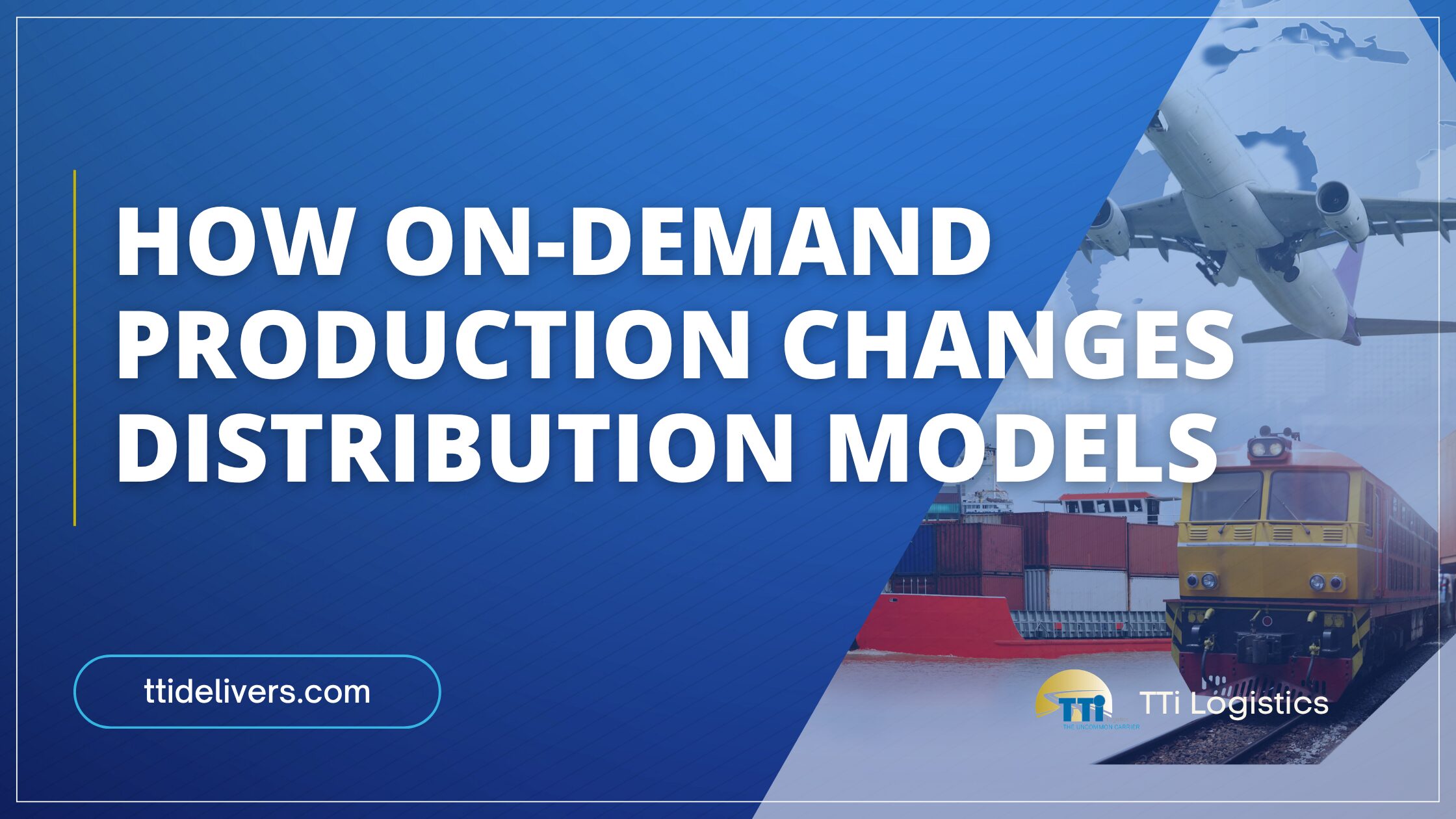
On-demand production is reshaping how goods are made, stored, and delivered—forcing companies to rethink distribution from the ground up. Instead of long production runs feeding massive regional warehouses, businesses are increasingly producing goods closer to the point of demand, in smaller quantities, and with far greater flexibility. This shift is accelerating the adoption of decentralized supply chains, fundamentally changing how distribution networks are designed and managed.
At TTi Logistics, we work with organizations navigating this transition every day. What’s becoming clear is that on-demand production doesn’t just optimize manufacturing—it rewires distribution logic entirely.
The Legacy Distribution Model Was Built for Predictability
Traditional distribution models were designed to support economies of scale. Large factories produced standardized goods in volume. Those goods flowed into centralized distribution centers, where inventory was stored until orders were placed. From there, products moved through regional hubs and eventually to customers.
This model worked well when demand was stable, lead times were forgiving, and customization was limited. Inventory acted as a buffer against uncertainty. Excess stock was inefficient but acceptable. Long transportation lanes were costly but manageable.
However, that model depends on forecasts being accurate months in advance—and in today’s market, they rarely are.
As product lifecycles shorten, customer expectations rise, and disruptions become more frequent, centralized distribution structures struggle to keep up. Inventory risk increases, fulfillment slows, and flexibility disappears precisely when it’s needed most.
On-Demand Production Breaks the Inventory-First Mindset
On-demand production flips the traditional sequence. Instead of manufacturing to forecast and distributing from storage, products are increasingly produced in response to real demand signals.
This may involve:
- Short production runs triggered by actual orders
- Modular manufacturing that allows late-stage customization
- Localized or regional production facilities
- Digital manufacturing technologies that reduce setup time
The result is less reliance on large inventory buffers and more emphasis on responsiveness.
Once production becomes demand-driven, distribution can no longer revolve around a single centralized inventory pool. Goods don’t sit idle waiting to be shipped—they move almost immediately after production. This naturally favors decentralized supply chains, where distribution nodes are positioned closer to end customers and aligned with real-time demand patterns.
Distribution No Longer Starts at the Warehouse
One of the most significant changes introduced by on-demand production is the shifting role of the warehouse.
In a centralized model, warehouses exist primarily to store inventory. In decentralized supply chains, warehouses increasingly function as flow-through nodes—facilitating rapid movement rather than long-term storage.
Distribution planning now begins upstream, at the point of production. Decisions about where goods are made directly influence how they are distributed, which transportation modes are used, and how quickly customers can be served.
This tighter coupling between production and distribution requires logistics networks that are far more dynamic. Static routing plans and fixed distribution hierarchies give way to flexible, adaptive models that can respond to changing demand in near real time.
Decentralized Supply Chains Redefine Network Design
Decentralized supply chains distribute inventory, production capacity, and fulfillment capabilities across multiple locations rather than concentrating them in a few massive hubs.
When paired with on-demand production, this approach creates several structural advantages:
- Production and fulfillment occur closer to customers, reducing transit time and last-mile complexity.
- Inventory levels drop because products move quickly from production to delivery.
- Risk is spread across multiple nodes instead of concentrated in a single facility.
From a distribution standpoint, this means fewer long-haul shipments and more regional or local movements. Transportation strategies shift toward shorter routes, higher frequency, and greater reliance on flexible carrier networks.
TTi Logistics supports these models by helping clients design transportation strategies that align with decentralized production footprints—ensuring speed, reliability, and cost control even as networks become more complex.
Transportation Becomes a Strategic Lever, Not a Cost Center
In traditional models, transportation was often treated as a downstream cost to be minimized. In decentralized supply chains enabled by on-demand production, transportation becomes a strategic enabler.
Faster production cycles mean tighter delivery windows. Smaller batch sizes require more frequent shipments. Distribution networks must absorb variability without sacrificing service levels.
This changes how transportation decisions are made. Flexibility, visibility, and carrier diversity become more important than rigid cost optimization. Logistics providers must be able to support rapid shifts in volume, routing, and mode selection without disruption.
Rather than optimizing for the lowest cost per mile, businesses increasingly optimize for speed to market, resilience, and customer experience—key benefits of decentralized supply chains when executed correctly.
Inventory Strategy Evolves from Stockpiling to Positioning
On-demand production reduces the need for large finished-goods inventories, but it doesn’t eliminate inventory altogether. Instead, inventory strategy shifts upstream.
Raw materials, components, and semi-finished goods are often positioned closer to production sites. Distribution planning focuses on ensuring these inputs are available where and when production is triggered.
This requires greater coordination between suppliers, manufacturers, and logistics partners. Distribution networks must support inbound flows that are just as agile as outbound deliveries.
TTi Logistics works with clients to balance inbound and outbound logistics in decentralized supply chains—ensuring production inputs arrive on time while finished products reach customers quickly.
Visibility Becomes the Backbone of Decentralized Distribution
Decentralized supply chains only work when visibility is strong. With production, inventory, and fulfillment spread across multiple locations, decision-makers need real-time insight into what’s happening across the network.
On-demand production increases the pace of operations, leaving little margin for error. Distribution models must rely on accurate data to synchronize production schedules, transportation capacity, and delivery commitments.
Without visibility, decentralization can create confusion instead of efficiency. With it, businesses gain unprecedented control and adaptability.
Customer Expectations Accelerate the Shift
Customer demand for speed, customization, and reliability is one of the strongest forces pushing companies toward on-demand production and decentralized supply chains.
Customers increasingly expect products to be available quickly and tailored to their needs. They’re less tolerant of backorders, delays, or generic offerings. Distribution models that rely on distant warehouses and long lead times struggle to meet these expectations.
On-demand production allows companies to respond directly to customer orders. Decentralized distribution ensures those orders are fulfilled quickly and efficiently. Together, they create a supply chain that feels responsive rather than rigid.
Risk Is Reduced Through Distribution Resilience
Centralized distribution models concentrate risk. When a single facility goes offline, the impact can ripple across an entire supply chain.
Decentralized supply chains distribute that risk. Production and fulfillment can shift between nodes when disruptions occur, whether due to weather, labor issues, or transportation constraints.
On-demand production enhances this resilience by reducing dependence on large inventory pools. When demand patterns change, production adjusts accordingly instead of leaving businesses stuck with obsolete stock.
From a distribution perspective, resilience becomes a design principle rather than a contingency plan.
Execution Requires Logistics Partners Built for Complexity
The shift toward on-demand production and decentralized supply chains introduces complexity—but it also creates opportunity. Companies that execute well gain speed, flexibility, and competitive advantage.
Execution depends heavily on logistics partners who understand how these systems function in practice. Transportation coordination, network design, inbound and outbound synchronization, and real-time visibility all play critical roles.
TTi Logistics supports businesses through this transition by providing scalable transportation solutions, strategic network guidance, and operational expertise tailored to decentralized distribution models.
The Future of Distribution Is Adaptive, Not Fixed
On-demand production is not a trend—it’s a structural shift. As manufacturing becomes more flexible and responsive, distribution models must evolve to match.
Decentralized supply chains offer a framework for that evolution, enabling businesses to move faster, reduce risk, and align operations with real customer demand.
The companies that succeed will be those that treat distribution as a living system—capable of adapting as production methods, technologies, and market expectations change.